Travel to the Peloponnese
West of Athens, it can be reached via the new highway towards Corinth in around 1.5 hours. The channel of the same name separates the Peloponnese from the Attiki mainland in the shape of a plane tree leaf. It is divided into seven regions and is washed by the Ionian Sea to the west and the Aegean Sea to the east.
The climate is mild in winter and hot in summer, with temperatures above 30 degrees Celsius. The water temperature is above 20 degrees Celsius from June to October. The ideal time to visit is mid-May and the month of June. Now Messinia & Laconia present us with all their colorful splendor. It glows everywhere in shades of yellow, purple and red. The lush green covers the otherwise rather barren maquis & the many aromas are in the air.
Nature shows its most beautiful dress and the sky is always blue. Spring is omnipresent. The water is already around 19 degrees Celsius. If that's still too cool for you, come in September or October. Then the sea is still around 21 degrees Celsius and the grapes are now being processed. Now the country is dominated by shades of brown and yellow. The fertile northwest region with agricultural land used for greenhouses, as well as oil and dairy production, is partly alluvial land and partly vast green areas. Wine, dairy products and agriculture are also strongly represented here. The abundance of herbs in Outer Mani, such as wild sage, thyme, rosemary, various types of droste and fennel, find their way into the local dishes of the region. As in all Greek places, the basis is their own olive oil. Seasonal vegetables such as zucchini, orchard greens, tomatoes and various types of legumes. The many summer salads are creatively dressed with wild dandelions (Hurta), fresh spinach, chard and wild capers and lemon grasses (Kritamos).
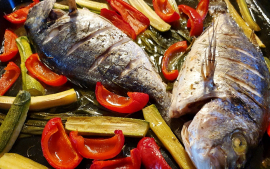
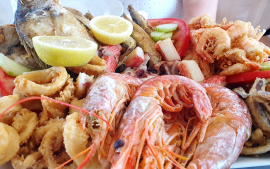
The regional cuisine is light and varied. Here, Messinian cuisine includes puff pastries filled with spinach and feta and/or peppers, as well as local fish and seafood in the psaratavernas. Local fish such as tsipura (bream), kotsoumura (mullet), gavros, sardella (sardine) lavrakis, maniatiko (ginikos (mackerel), or rofos (perch) and scorpios (scorpionfish) for soup are still freshly caught on the daily menu. Traditionally, meat is roasted over charcoal in the psisterias (barbecues). Souvlaidikas (gyros take-aways) offer souvlakis, pitta giros and kebab variations for little money and "just in time". Here, too, the choice is huge and the local restaurants outdo each other with different flavors and sauces. In the fall and winter months, hearty stews with goat and lamb dishes are served over the fire. With advance booking and a bit of luck, wild boar and rabbit are also available.
At Kyllini, kilometers of sandy beaches (here the beaches are mostly unorganized, as the native Caretta-Caretta sea turtle lays its eggs in the summer months of July and August) stretch along largely undeveloped stretches of coastline with the Pirgos hub and the important UNESCO site of Olympia. The south-west route, which continues mainly along beautiful coastal roads, leads all the way to Messinia. Methoni (with its old "pirate fortress") and the old coastal town of Koroni have a very special atmosphere. The Gialova Lagoon in Romanos near Pylos is a protected plant and animal biotope. Excursion tip: the new sea finds museum in the fortress of Pylos above the old town.
We meet in Kalamata, in the beautiful, upper old town, where the old follows the new. A city in transition. Ferry connections to Crete and the bathing and snorkeling paradise of Kithira are among the attractive excursion destinations from here. Following the coastal road through the gray Taygethos Mountains, heading south, you pass through small communities and into the over 2000 year old & picturesque Kardamili. About 45 kilometers further south, the Inner Mani impresses with its sobriety and its unique residential towers. Areopolis as a center with the beautiful old town and the many (open) chapels is certainly worth a stop. Hiking and trekking enthusiasts will find a challenging terrain of varying difficulty here.
Buildings from the Byzantine period, castles, churches and defensive walls can be found everywhere. The witnesses of religion in the form of frescoes and wall paintings are famous among experts and deserve special attention. Just as the Taygethos Mountains run through the Mani, the Parnon stretches all the way to Arcadia. The eastern finger is sparsely populated and has wide, hilly meadows.
It is worth following the only road from the north to Moni Em Vasia, Laconia. You too will succumb to the special charm of this old fortress. The quickest way back towards Korinthos is through Laconia via Sparta and Tripoli, which is rich in excavations and relics of earlier Greek civilizations. If you choose the country road at Skala, you will also bridge an altitude difference of almost 2000 meters and feel as if you have been transported to the Alps. This is followed by a wide olive valley plain and you find yourself on the Greek C`ote Azur. Steep coastlines and beautiful sandy bays make the ride another feast for the eyes. Passing Napflion, which is certainly worth a detour, ancient Argos as the cradle of Mycenaean culture is worth mentioning. The orange and lemon groves stretch for miles along the wine route almost as far as Corinth.
Nowhere else are there so many important sights within such a small radius as on the Peloponnese. Here alone, UNESCO has designated 4 of Greece's 9 ancient sites as World Heritage Sites. Day excursions to the famous sites of early civilization such as Olympia, Mistras, Mycenae or lesser-known historical sites such as Methoni and Monemvasia are certainly among the highlights.
Here, far away from the hustle and bustle, you can indulge in traditional Greek cuisine. The tavern owners are proud of their home-made wine and olive oil.
The first organic olive oil in Greece came from Stoupa. The bread, traditionally baked in stone ovens, is part of every local meal, just like the fresh spring water.
The Greek parea is a social event and is often the highlight of the day. People take their time eating and the lack of clearing up leftovers is not down to the carelessness of the host.
As everywhere in Greece, children are very welcome and always present. It is customary to eat late
... and in this private atmosphere, the guest quickly becomes a local.